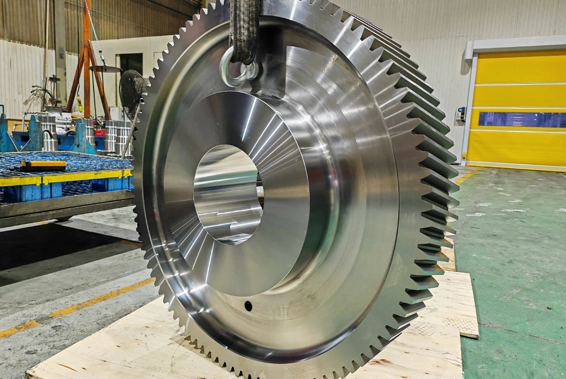
Key Aspects of DIN Level 5 Forged Gears:
1. DIN 3962 Standard:
The DIN 3962 standard defines the gear quality levels based on parameters such as accuracy of tooth profile, helix deviation, and runout. Level 5 is a high precision classification, indicating:
Very tight tolerances on tooth geometry.
Excellent smoothness in operation.
Minimal noise and vibration during use.
2. Forging Process:
Closed-Die Forging: Used to create complex shapes with excellent dimensional accuracy and strength.
Open-Die Forging: The forging process aligns the grain structure of the metal, resulting in improved fatigue resistance and impact strength compared to cast or machined gears.
3. High-Performance Materials & Metallurgical Benefits
We select premium alloy steels to ensure our DIN Level 5 forged gears meet the most demanding operational requirements. Each material is chosen for its specific mechanical properties:
20CrMnTiH: The Standard for Heavy-Duty Performance
As a premier carburizing steel, 20CrMnTiH offers an exceptional balance of core toughness and extreme surface hardness (typically 58-62 HRC after heat treatment). It is the ideal choice for heavy-duty automotive gears, transmission systems, and differentials where high impact resistance is required.
18CrNiMo7-6: Engineered for High-Torque Extremes
This high-alloy steel is known for its superior hardenability and fatigue strength. It is the preferred material for wind turbine gearboxes and high-load industrial drives. Its ability to withstand massive torque without tooth deformation makes it essential for long-term reliability in harsh environments.
42CrMo4 (AISI 4140): Versatility and Strength
A high-strength chromium-molybdenum steel that responds excellently to quenching and tempering. We recommend this for large-scale industrial machinery and structural gear components that require a high strength-to-weight ratio and consistent dimensional stability.
16MnCr5: Precision with Wear Resistance
Specifically used for gears requiring high surface wear resistance but moderate core stress. It is frequently applied in robotics, CNC precision tools, and light-to-medium duty gearboxes where DIN 5 accuracy must be maintained over a long service life.
4. Applications:
DIN Level 5 forged gears are used in high-performance and critical applications, including:
Automotive: Gearboxes and differentials in performance or heavy-duty vehicles.
Industrial Machinery: Robotics, CNC machines, and heavy-duty equipment.
Wind Energy: Gearboxes in wind turbines requiring durability and precision.
5. Advantages of DIN Level 5 Forged Gears:
High Strength: Withstand high loads and stresses in demanding environments.
Precision and Smooth Operation: Ensures efficient power transmission with minimal energy loss.
Reduced Noise and Vibration: Essential for applications requiring quiet and stable operation.
Extended Lifespan: Resistance to wear, fatigue, and environmental factors.
6. Typical Features:
Excellent dimensional consistency due to forging.
High resistance to deformation under load.
Tailored properties through additional machining and heat treatments.
DIN Level 5 forged gears are synonymous with quality and reliability, making them a preferred choice in industries where precision and durability are paramount.
Technical Specifications: DIN Level 5 Forged Gears
| Feature | Technical Standards & Capabilities |
| Accuracy Grade | DIN 3962 Class 5 / AGMA 12-13 Equivalent |
| Forging Method | High-precision Closed-Die Forging & Heavy-duty Open-Die Forging |
| Grain Flow | Optimized Continuous Grain Flow for Enhanced Fatigue Resistance |
| Material Grades | Alloy Steels: 20CrMnTiH, 18CrNiMo7-6, 42CrMo4 (AISI 4140), 16MnCr5 |
| Heat Treatment | Case Hardening (58-62 HRC), Nitriding, Quenching & Tempering |
| Surface Finish | Precision Ground (Ra ≤ 0.8 μm) |
| Module Range | M1.5 to M25 (Custom modules available upon request) |
| Max Diameter | Up to 2,500 mm (Depending on forging complexity) |
| Inspection Support | Ultrasonic (UT), Magnetic Particle (MT), CMM Dimensional Analysis |
Summary of Capabilities: WALKSON specializes in the manufacturing of DIN Level 5 forged gears, combining advanced closed-die forging technology with precision CNC grinding. By utilizing high-grade alloys like 18CrNiMo7-6, we ensure that our gears deliver exceptional load-bearing capacity and minimal noise for critical applications in wind energy and heavy industrial machinery.
Case Study: Custom Forged Gears for Wind Energy
Challenge:
A leading wind turbine manufacturer required high-precision yaw and pitch gears capable of enduring extreme torque and corrosive offshore environments. The primary challenge was reducing transmission noise while extending the maintenance cycle beyond 20 years.
Solution:
WALSON provided custom DIN Level 5 forged gears manufactured from 18CrNiMo7-6 alloy steel. Utilizing our advanced closed-die forging process, we achieved a superior grain flow structure that significantly increased fatigue resistance. The gears underwent precise carburizing and quenching to ensure a surface hardness of 58-62 HRC, followed by meticulous CNC profile grinding to meet the DIN 3962 Class 5 accuracy standard.
Result:
The implemented solution resulted in a 15% reduction in vibration-induced noise and a significant increase in load-bearing capacity. Our client reported zero fatigue-related failures during the first 3 years of operation, optimizing their turbine uptime and reducing overall maintenance costs.
Have a similar project? Contact WALKSON's technical team for a customized gear solution today."
 English
  Deutsch
  français
  русский
  فارسی
فارسی  العربية
  Español
  日本語
日本語  한국어
한국어  italiano
  português
  dansk
dansk  Suomi
Suomi